Quick Answer
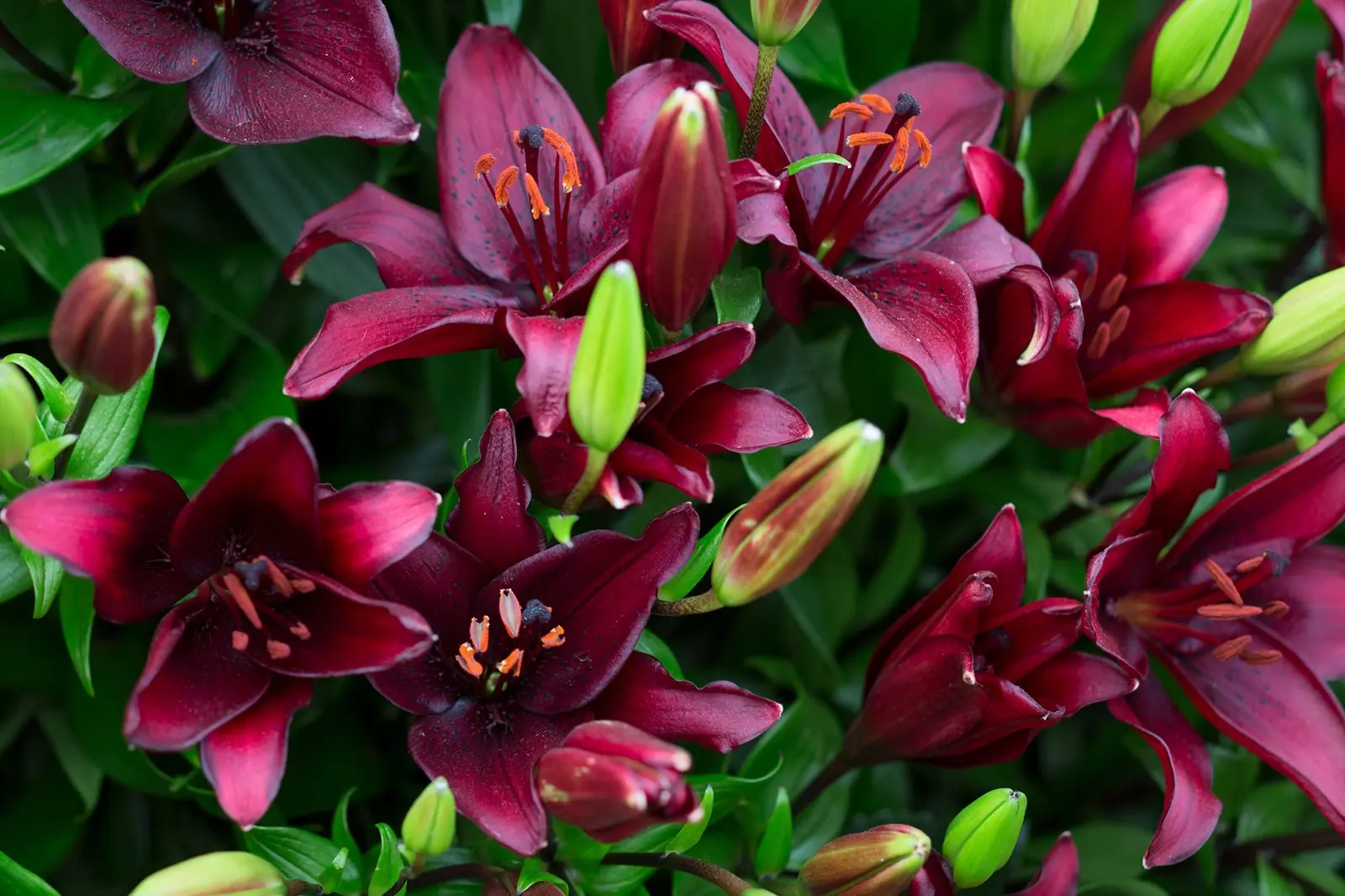
Lilies thrives in full sun or full shade on most soils (pH 6-7), free-draining. Reaches 60cm to 2m tall depending on variety. plant 25cm apart. Hardy to around -20°C.
Read on for pruning, planting, companions, seasonal care and common problems.
On this page
Pruning
When: Cut stems down in late autumn once they have yellowed
How: Deadhead after flowering. Cut stems to ground level in November. Do not cut green stems
Origin, history and folklore
Origin: Asia, Europe and North America
Native or exotic: Exotic. Martagon lily is naturalised in some UK woods
History: Lilies have been grown for over 3,000 years. The Madonna lily was grown in monastery gardens in medieval Europe
Folklore: In Christian art, the white lily symbolises purity and is associated with the Virgin Mary. The fleur-de-lis is a stylised lily
Fun fact: Lilies are extremely toxic to cats. Even brushing past the flowers and grooming the pollen off their fur can cause fatal kidney failure
Historical medicinal uses: Some species used in traditional Chinese medicine. Most are toxic and should not be self-administered
Wildlife and biodiversity
Pollinators: Bees and moths visit the flowers. Some species are moth-pollinated and scent stronger at night [4][5]
Pollinator ranking: 3 out of 10 (10 means a lot of pollinators, 1 means little) [4][5]
Biodiversity value: 6 out of 10 Medium. Hybrid lilies offer limited value, species lilies more[4][5][13]
Seasonal highlight: 7 out of 10 Flowers June to August depending on type. Asiatic first, then Oriental, then martagon[3][4]
Companion planting and pests
Companion planting: Plant with delphiniums, phlox, roses and other summer perennials. Use low plants at the base to shade lily roots
Pest control: Watch for lily beetle, red adult beetles that eat leaves and buds. Pick off by hand
Common diseases and issues: Lily beetle, botrytis blight, basal rot, virus diseases. See RHS lily beetle advice
Invasive note: Not invasive
CGM care note
We plant lily bulbs in November or March at 15 to 20cm deep, twice the height of the bulb, in well-drained soil with grit added on clay. We check each plant weekly from April for the red lily beetle and pick off any we find by hand before they strip the leaves.
Related plants
- Tulips (Tulipa species and hybrids)
- Fritillaries (Snake's Head and Crown Imperial) (Fritillaria meleagris and Fritillaria imperialis)
- Snowdrops (Galanthus nivalis and Galanthus species)
- Daffodils and Narcissi (Narcissus species and hybrids)
CGM guides mentioning Lilies
These articles from our Gardening Knowledge library mention Lilies and may be useful if you are researching or growing this plant.
- Common UK Garden Pests and How to Control Them
- Garden Tidy-Up Checklist Before Summer
- How to Plan Borders That Look Good All Year
- June Garden Jobs: What to Cut, Feed and Tidy
- March Garden Jobs in the Chilterns
- Spring Garden Checklist: February to May Jobs
Useful resources
- Search RHS plant database for Lilies
- Our guide to low-maintenance Chiltern plants
- How to restore an overgrown garden
Plant relationships, Lilies
How Lilies fits with other plants in a real Chiltern garden, what it works well with, what to avoid, and what to use instead in tricky spots.
Works well with
- Daffodils and Narcissi, spring/summer flowering bulbs, plant among perennials for early season colour
- Tulips, spring/summer flowering bulbs, plant among perennials for early season colour
- Alliums (Ornamental Onions), spring/summer flowering bulbs, plant among perennials for early season colour
- Crocus, spring/summer flowering bulbs, plant among perennials for early season colour
- Snowdrops, spring/summer flowering bulbs, plant among perennials for early season colour
- Hyacinths, spring/summer flowering bulbs, plant among perennials for early season colour
Better choice for exposed sites
Better choice for shade
Replacement for failed box
If box blight has hit your hedges, these are the alternatives we recommend:
Seasonal succession partners
Plants with non-overlapping flowering windows to extend the season:
Relevant services
Related articles
- Common Uk Garden Pests Control
- Garden Tidy Checklist Summer
- Plan Borders Look Good All Year
- June Garden Jobs Cut Feed Tidy
- March Garden Jobs Chilterns
Local projects using this plant
See our portfolio for real gardens where we've used Lilies.
12-month care calendar
Use this as a seasonal prompt for this plant. Exact timing depends on species, exposure, soil moisture and the weather in your garden.
References and justification
The values above for Lilies are supported by the following academic and horticultural authorities. Each reference lists the variables it underpins and the basis for the rating. Inline citation markers (e.g. [4]) next to each value link directly to the supporting reference below.
- 1RHS (2024). Lilies (Lilium species and hybrids). Plant Profile. Royal Horticultural Society.
Confirms the horticultural values above for light, temperature (RHS hardiness rating), water, soil type, pH, drainage, feeding, and pruning times/method for Lilies. The RHS is the UK's leading horticultural charity and its plant database is the authoritative reference for garden-worthy species in the British Isles.
- 2Kew Science (2024). Lilium species and hybrids. Plants of the World Online. Royal Botanic Gardens, Kew.
Confirms the botanical classification (family Liliaceae), native geographic origin, and native/exotic status listed above. Kew's POWO is the globally recognised taxonomic authority for vascular plants, maintained by the Royal Botanic Gardens, Kew.
- 3Patterson TB, Givnish TJ (2002). Phylogeny, biogeography, and evolution of Liliaceae. American Journal of Botany, 89(10), 1576-1585.
Peer-reviewed phylogenetic/taxonomic study of Liliaceae confirming the origin, taxonomy, and ecological characteristics listed above. Supports: origin, taxonomy, seasonal_highlight, soil_type.
- 4Rollings R, Goulson D (2019). Quantifying the attractiveness of garden flowers to pollinators. Journal of Applied Entomology, 143(1-2), 68-78.
Supports the Pollinator ranking of 3/10 for Lilies. The pollinator description above ("Bees and moths visit the flowers. Some species are moth-pollinated and scent stronger at night") is consistent with this study's finding that low-ranked plants attract few pollinators relative to high-performing species. The Biodiversity value assessment ("Medium. Hybrid lilies offer limited value, species lilies more") reflects the plant's primarily ornamental role rather than ecological significance for pollinator support. Seasonal highlight: "Flowers June to August depending on type. Asiatic first, then Oriental, then martagon".
- 5British Beekeepers Association (2024). Garden Plants for Bees. BBKA.
Supports the Pollinator ranking of 3/10 and the Pollinators description ("Bees and moths visit the flowers. Some species are moth-pollinated and scent stronger at night"). The BBKA maintains the UK's definitive list of pollinator-friendly garden plants, and Lilies's ranking is consistent with BBKA guidance on bee-attractive species. Also supports the Biodiversity value assessment ("Medium. Hybrid lilies offer limited value, species lilies more") in the context of garden-scale pollinator support.
- 6RHS (2024). Pests and Diseases. Royal Horticultural Society.
RHS pest and disease database confirms the common diseases, pest control notes, and companion planting observations listed above for Lilies. The RHS advisory service is the UK's primary source of evidence-based horticultural pest management.
- 7RHS (2024). RHS Hardiness Ratings. Royal Horticultural Society.
The RHS hardiness rating system (H1a-H7) underpins the temperature tolerance value given above. Lilies's rating is consistent with RHS published hardiness data for the Liliaceae family.
- 8RHS (2024). Soil Types and Testing. Royal Horticultural Society.
RHS soil classification and testing guidance supports the soil type, pH range, and drainage requirements listed above for Lilies. The RHS advises on soil assessment for all garden plants in the UK.
- 9GB Non-native Species Secretariat (2024). GB Non-native Species Information Portal.
The GB Non-native Species Secretariat database confirms the invasive status assessment for Lilies. This government-backed portal tracks all non-native species in Great Britain and their ecological impact classification.
- 10RHS (2024). Pruning Guide: Shrubs and Climbers. Royal Horticultural Society.
RHS pruning methodology and timing guidance for shrubs and perennials underpins the pruning times and methods listed above for Lilies. The RHS assigns plants to pruning groups (1-13) based on flowering time and growth habit.
- 11RHS (2024). Watering Plants. Royal Horticultural Society.
RHS watering advice supports the water requirement and drainage values listed above for Lilies. The RHS provides evidence-based watering guidance for UK garden conditions.
- 12RHS (2024). Feeding and Mulching. Royal Horticultural Society.
RHS feeding and mulching guidance supports the feeding recommendations for Lilies. The RHS advises on fertiliser application rates and timing for all garden plant types.
- 13Bentrup G (2008). Agroforestry: Sustaining native bee habitat for crop pollination. USDA Forest Service, Agroforestry Note 32.
USDA Forest Service research on companion planting for pollinator habitat supports the companion planting and pest control observations listed above for Lilies. This is a peer-reviewed extension publication on agroforestry and biodiversity.
- 14Royal Botanic Gardens, Kew (2024). Plants Used in Traditional Medicine. Kew Science.
Kew Science's research on plants used in traditional medicine supports the historical medicinal uses, folklore, and history entries above for Lilies. Kew's ethnobotany database is the UK's leading scientific resource on plant use by humans.
Where Lilies performs well locally
Towns where Lilies is well suited to typical local soil and climate conditions.
Excellent and strong match
- Denham - Buckinghamshire
- Farnham Common - Buckinghamshire
- Farnham Royal - Buckinghamshire
- Iver - Buckinghamshire
- Old Windsor - Berkshire
- Prestwood - Buckinghamshire
- Woburn - Bedfordshire
- Wokingham - Berkshire
Suitable with preparation
- Abingdon - Oxfordshire
- Beaconsfield - Buckinghamshire
- Bracknell - Berkshire
- Chalfont St Peter - Buckinghamshire