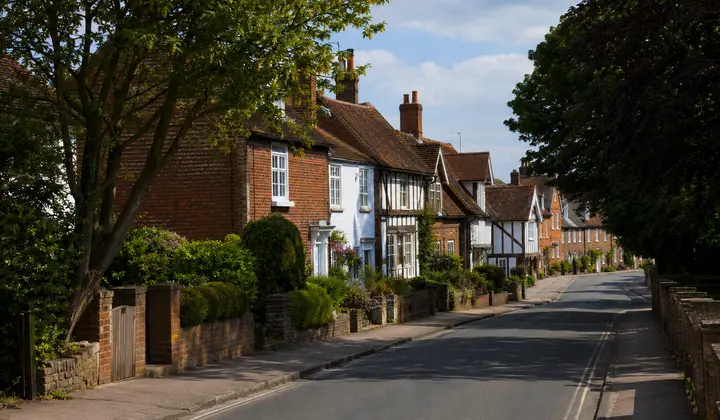
Local conditions in Amersham
Geology and soil
Chalk in the valley bottom, clay-with-flints on the hillsides and hilltops.
Soil type: Shallow chalky loam in the valley. Heavy clay-loam with flints on the hills.
Soil pH: Alkaline in the valley, pH 7.5 to 8.0. Neutral to slightly acidic on the hills, pH 6.5 to 7.0.
Rainfall
Annual rainfall: Approximately 720mm per year. Slightly wetter than the surrounding area.
Monthly pattern: Wettest October to January at 70 to 80mm. Driest July and August at 45 to 50mm.
Temperature
Annual average 10.3C. Summer highs 22C. Winter lows 1C. Frost pockets in the valley.
Garden types in the area
Historic cottages and townhouses in Old Amersham, larger family homes on the hills, modern developments around Amersham-on-the-Hill.
Local conditions to consider
Steep slopes, frost pockets in the valley, mature beechwoods nearby providing leaf mould for mulch.
Services Most Relevant to Amersham
Based on the local conditions, these are the services we are most often asked for in Amersham:
Plants That Thrive in Amersham
Given the local soil and conditions, these are plants we use regularly in Amersham gardens:
Nearby Areas We Also Cover
- Chesham
- Chalfont St Giles
- Little Chalfont
- Great Missenden
Get a Quote in Amersham
If you are in Amersham, a nearby village or a surrounding hamlet and need help with your garden, contact us on WhatsApp. We regularly cover the surrounding area and will aim to respond within 12 to 36 hours, Monday to Sunday. We arrange all quotes during a free site visit.
Useful Local Resources
Plants suited to typical Amersham conditions
Based on typical local conditions. Individual gardens can vary, particularly where soil has been imported or heavily amended.
Also suitable with preparation
- Wildflower Meadow Mixes - Requires soil preparation or local adaptation
- Holly - Requires soil preparation or local adaptation
- Cherry Laurel - Requires soil preparation or local adaptation
- Beech - Requires soil preparation or local adaptation
- Cotoneaster - Requires soil preparation or local adaptation
- Hazel - Requires soil preparation or local adaptation
12-month garden calendar for Amersham
Based on typical local conditions. Individual gardens can vary, particularly where soil has been imported or heavily amended.
Seasonal timing is approximate. Adjust tasks for the actual weather, soil condition and development of your plants.
January: Protect structure and monitor winter ground
- Protect tender plants with fleece or move to greenhouse
Watch for: frost damage to tender growth, prolonged standing water.
February: Late winter pruning and soil preparation
- Avoid walking on frosted lawns to prevent damage
- Cut back spring-flowering shrubs after bloom
Watch for: frost damage to tender growth, prolonged standing water, over-pruning reducing flowering potential.
March: Spring begins - soil warming, prepare beds
- Check pots are raised off the ground to prevent waterlogging
- Transplant seedlings when soil has warmed
- Remove dead, diseased and crossing branches
- Aerate compacted areas and top-dress with sand
- Inspect the undersides of leaves for pests
Watch for: frost damage to tender growth, prolonged standing water, late frost damaging new growth, dry soil preventing germination, over-pruning reducing flowering potential, moss invasion in compacted or shaded areas, aphid colonies on new growth, slug damage on tender shoots.
April: Planting and sowing in earnest
- Sow hardy annuals directly into prepared beds
- Mow when grass is dry and growing
- Apply a 5cm layer of mulch around hungry plants
- Check for aphids on new growth and squash by hand
Watch for: late frost damaging new growth, dry soil preventing germination, moss invasion in compacted or shaded areas, over-feeding causing soft, disease-prone growth, aphid colonies on new growth, slug damage on tender shoots.
May: Peak planting - mind late frost risk
- Plant bare-root trees and shrubs while dormant
- Scarify to remove thatch and moss
- Feed with a balanced fertiliser as growth resumes
- Use a watering can for targeted watering of new plants
- Stake tall flowers before they flop
- Look for slug damage on tender shoots
Watch for: late frost damaging new growth, dry soil preventing germination, moss invasion in compacted or shaded areas, over-feeding causing soft, disease-prone growth, drought stress on newly planted stock, dead flowers harbouring fungal disease if not removed, aphid colonies on new growth, slug damage on tender shoots.
June: Summer maintenance and watering
- Remove dead, diseased and crossing branches
- Aerate compacted areas and top-dress with sand
- Install water butts to capture rainfall
- Cut flowers for the house in the morning when stems are full of water
- Inspect the undersides of leaves for pests
Watch for: over-pruning reducing flowering potential, moss invasion in compacted or shaded areas, drought stress on newly planted stock, dead flowers harbouring fungal disease if not removed, aphid colonies on new growth, slug damage on tender shoots.
July: Peak summer deadheading
- Mow when grass is dry and growing
- Water early morning or evening to reduce evaporation
- Deadhead flowering perennials to extend the display
- Check for aphids on new growth and squash by hand
Watch for: moss invasion in compacted or shaded areas, drought stress on newly planted stock, dead flowers harbouring fungal disease if not removed, aphid colonies on new growth, slug damage on tender shoots.
August: Late summer maintenance and harvest
- Cut back spring-flowering shrubs after bloom
- Scarify to remove thatch and moss
- Use a watering can for targeted watering of new plants
- Stake tall flowers before they flop
- Look for slug damage on tender shoots
Watch for: over-pruning reducing flowering potential, moss invasion in compacted or shaded areas, drought stress on newly planted stock, dead flowers harbouring fungal disease if not removed, aphid colonies on new growth, slug damage on tender shoots.
September: Autumn transition - planting and lawn care
- Transplant seedlings when soil has warmed
- Aerate compacted areas and top-dress with sand
- Top up compost bins with garden waste
- Cut flowers for the house in the morning when stems are full of water
- Inspect the undersides of leaves for pests
Watch for: late frost damaging new growth, dry soil preventing germination, moss invasion in compacted or shaded areas, over-feeding causing soft, disease-prone growth, dead flowers harbouring fungal disease if not removed, aphid colonies on new growth, slug damage on tender shoots.
October: Leaf fall, planting and winter preparation
- Sow hardy annuals directly into prepared beds
- Mow when grass is dry and growing
- Apply a 5cm layer of mulch around hungry plants
Watch for: late frost damaging new growth, dry soil preventing germination, moss invasion in compacted or shaded areas, over-feeding causing soft, disease-prone growth.
November: Dormancy - planting and protection
- Avoid walking on frosted lawns to prevent damage
- Plant bare-root trees and shrubs while dormant
- Cut back spring-flowering shrubs after bloom
Watch for: frost damage to tender growth, prolonged standing water, late frost damaging new growth, dry soil preventing germination, over-pruning reducing flowering potential.
December: Mid-winter - rest and plan
- Check pots are raised off the ground to prevent waterlogging
- Remove dead, diseased and crossing branches
Watch for: frost damage to tender growth, prolonged standing water, over-pruning reducing flowering potential.
View this calendar on the seasonal calendar page
Services most commonly required in Amersham
Based on local soil type, drainage, frost patterns and seasonal conditions, these are the services we are most often called out for in this area.
Soft Landscaping
Frequently required in this area, driven by local soil and seasonal conditions.
Find out more →Garden Clearance
Commonly requested, driven by local soil and seasonal conditions.
Find out more →Hedge Cutting
Commonly requested, driven by local soil and seasonal conditions.
Find out more →Soil and exposure patterns in Amersham
Soil type
Shallow chalky loam in the valley. pH 7.5-8.0 (alkaline).
Drainage
Free-draining chalk. Quick to dry, may need mulch to retain moisture.
Frost & exposure
Variable. Local frost pockets possible in low-lying areas.
Rainfall & drought
720mm per year (typical for the UK)
Seasonal issues specific to Amersham
These are the seasonal issues we see most often in Amersham gardens, drawn from our local work and the town's soil and climate profile.
- Spring drought stress on chalk soils in Amersham, water new plantings weekly through the first summer, as chalk drains faster than most gardeners expect
- Alkaline soil (pH 7.5-8) limits acid-loving plants, rhododendrons, camellias and blueberries will struggle without ericaceous containers or imported soil
- Shallow soil depth on chalk escarpment around Amersham, large trees may need staking longer and watering more in dry spells
- Free-draining conditions around Amersham, lawns may need supplemental irrigation in July and August
- Cold air drains down the hillsides around Amersham, frost pockets form at the base of slopes, so plant tender species higher up where possible
Preconfigured estimator for Amersham
Based on local conditions, the Soft Landscaping estimator is the most relevant starting point for gardens in this area. Open it preconfigured with typical Amersham conditions.