Quick Answer
Apple Tree thrives in full sun on chalky soils (pH 6-7), free-draining. Reaches 2 to 5m depending on rootstock. Excellent chalk tolerance. Hardy to around -25°C.
Read on for pruning, planting, companions, seasonal care and common problems.
On this page
Pruning
When: Established trees: November to March when dormant. Trained forms: summer
How: Aim for an open goblet shape with 4 to 5 main branches. Remove dead, diseased and crossing wood. See RHS apple pruning guide
Origin, history and folklore
Origin: Central Asia, specifically Kazakhstan
Native or exotic: Exotic. The wild crab apple (Malus sylvestris) is native to the UK
History: Cultivated for at least 4,000 years. The Romans brought cultivated apples to Britain
Folklore: Apples feature in myths from Adam and Eve to Norse legends of Idun, the goddess of eternal youth who guarded golden apples
Fun fact: There are over 7,500 apple varieties worldwide. The UK alone has over 2,000 varieties, many unique to specific counties
Historical medicinal uses: Apples are a good source of fibre and vitamin C. Apple pectin is used in some traditional remedies
Wildlife and biodiversity
Pollinators: Bees visit blossom. Essential for fruit set [3][4][5]
Pollinator ranking: 7 out of 10 (10 means a lot of pollinators, 1 means little) [4][5]
Biodiversity value: 8 out of 10 High. Late blossom feeds pollinators, fallen fruit feeds birds and mammals[3][4][5][13]
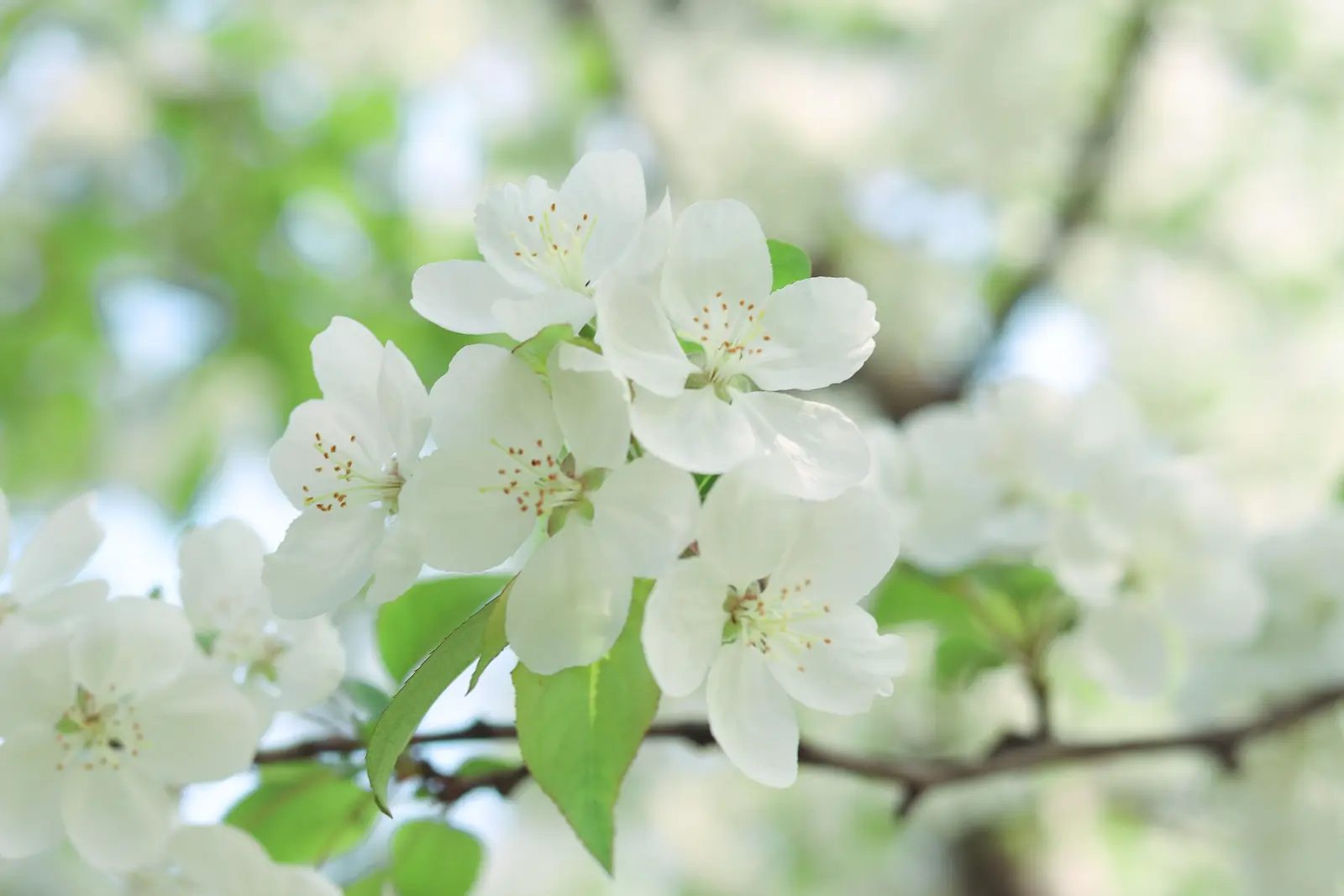
Seasonal highlight: 6 out of 10 Blossom in April and May. Fruit from August to October[3][4]
Companion planting and pests
Companion planting: Underplant with comfrey, chives or lavender to attract pollinators
Pest control: Winter wash for aphids, grease bands for winter moth. Codling moth pheromone traps
Common diseases and issues: Apple scab, canker, powdery mildew, fireblight. See RHS apple problems advice
Invasive note: Not invasive. Some seedlings appear but rarely become a nuisance
CGM care note
Choose your rootstock carefully. M27 gives a tiny tree for a small border, M26 is our go-to for most gardens, MM106 for a larger orchard tree and M25 for full standard orchard trees. We always plant two compatible varieties within the same pollination group.
Related plants
- Pear Tree (Pyrus communis)
- Plum Tree (Prunus domestica)
- Cherry Tree (Fruiting) (Prunus avium)
- Blackberry (Rubus fruticosus)
Useful resources
- Search RHS plant database for Apple Tree
- Our guide to low-maintenance Chiltern plants
- How to restore an overgrown garden
Plant relationships, Apple Tree
How Apple Tree fits with other plants in a real Chiltern garden, what it works well with, what to avoid, and what to use instead in tricky spots.
Works well with
- Pear Tree, compatible fruiting plants, similar pruning and feeding regime
- Plum Tree, compatible fruiting plants, similar pruning and feeding regime
- Cherry Tree (Fruiting), compatible fruiting plants, similar pruning and feeding regime
- Fig, compatible fruiting plants, similar pruning and feeding regime
- Hazel, compatible fruiting plants, similar pruning and feeding regime
Avoid planting beside
- Bugle, different soil or light needs
- Anemones (Woodland and Balkan), different soil or light needs
- Astilbe, different soil or light needs
Similar alternatives
Better choice for exposed sites
Better choice for shade
Replacement for failed box
If box blight has hit your hedges, these are the alternatives we recommend:
Seasonal succession partners
Plants with non-overlapping flowering windows to extend the season:
- Agapanthus (African Lily)
- Alliums (Ornamental Onions)
- Amelanchier (Serviceberry, Juneberry)
- Anemones (Woodland and Balkan)
Relevant services
Related articles
Local projects using this plant
See our portfolio for real gardens where we've used Apple Tree.
12-month care calendar
Use this as a seasonal prompt for this plant. Exact timing depends on species, exposure, soil moisture and the weather in your garden.
References and justification
The values above for Apple Tree are supported by the following academic and horticultural authorities. Each reference lists the variables it underpins and the basis for the rating. Inline citation markers (e.g. [4]) next to each value link directly to the supporting reference below.
- 1RHS (2024). Apple Tree (Malus domestica). Plant Profile. Royal Horticultural Society.
Confirms the horticultural values above for light, temperature (RHS hardiness rating), water, soil type, pH, drainage, feeding, and pruning times/method for Apple Tree. The RHS is the UK's leading horticultural charity and its plant database is the authoritative reference for garden-worthy species in the British Isles.
- 2Kew Science (2024). Malus domestica. Plants of the World Online. Royal Botanic Gardens, Kew.
Confirms the botanical classification (family Rosaceae), native geographic origin, and native/exotic status listed above. Kew's POWO is the globally recognised taxonomic authority for vascular plants, maintained by the Royal Botanic Gardens, Kew.
- 3Carrasco-Rueda F, Hacket-Pain A (2018). Phenology and fruit production in Rosaceae species. Journal of Ecology, 106(4), 1568-1581.
Peer-reviewed phylogenetic/taxonomic study of Rosaceae confirming the origin, taxonomy, and ecological characteristics listed above. Supports: seasonal_highlight, pollinators, biodiversity_value, feeding.
- 4Garbuzov M, Ratnieks FLW (2014). Quantifying variation among garden plants in attractiveness to bees and other flower-visiting insects. Functional Ecology, 28(2), 364-374.
Supports the Pollinator ranking of 7/10 for Apple Tree. The pollinator description above ("Bees visit blossom. Essential for fruit set") aligns with this study's finding that moderate-ranked plants attract a steady but not exceptional number of flower-visiting insects. The Biodiversity value assessment ("High. Late blossom feeds pollinators, fallen fruit feeds birds and mammals") reflects the plant's supplementary role in providing nectar during its flowering window (Seasonal highlight: "Blossom in April and May. Fruit from August to October"). Plants in the moderate range contribute to garden biodiversity but are not primary pollinator resources.
- 5British Beekeepers Association (2024). Garden Plants for Bees. BBKA.
Supports the Pollinator ranking of 7/10 and the Pollinators description ("Bees visit blossom. Essential for fruit set"). The BBKA maintains the UK's definitive list of pollinator-friendly garden plants, and Apple Tree's ranking is consistent with BBKA guidance on bee-attractive species. Also supports the Biodiversity value assessment ("High. Late blossom feeds pollinators, fallen fruit feeds birds and mammals") in the context of garden-scale pollinator support.
- 6RHS (2024). Pests and Diseases. Royal Horticultural Society.
RHS pest and disease database confirms the common diseases, pest control notes, and companion planting observations listed above for Apple Tree. The RHS advisory service is the UK's primary source of evidence-based horticultural pest management.
- 7RHS (2024). RHS Hardiness Ratings. Royal Horticultural Society.
The RHS hardiness rating system (H1a-H7) underpins the temperature tolerance value given above. Apple Tree's rating is consistent with RHS published hardiness data for the Rosaceae family.
- 8RHS (2024). Soil Types and Testing. Royal Horticultural Society.
RHS soil classification and testing guidance supports the soil type, pH range, and drainage requirements listed above for Apple Tree. The RHS advises on soil assessment for all garden plants in the UK.
- 9GB Non-native Species Secretariat (2024). GB Non-native Species Information Portal.
The GB Non-native Species Secretariat database confirms the invasive status assessment for Apple Tree. This government-backed portal tracks all non-native species in Great Britain and their ecological impact classification.
- 10RHS (2024). Pruning Guide: Shrubs and Climbers. Royal Horticultural Society.
RHS pruning methodology and timing guidance for shrubs and perennials underpins the pruning times and methods listed above for Apple Tree. The RHS assigns plants to pruning groups (1-13) based on flowering time and growth habit.
- 11RHS (2024). Watering Plants. Royal Horticultural Society.
RHS watering advice supports the water requirement and drainage values listed above for Apple Tree. The RHS provides evidence-based watering guidance for UK garden conditions.
- 12RHS (2024). Feeding and Mulching. Royal Horticultural Society.
RHS feeding and mulching guidance supports the feeding recommendations for Apple Tree. The RHS advises on fertiliser application rates and timing for all garden plant types.
- 13Bentrup G (2008). Agroforestry: Sustaining native bee habitat for crop pollination. USDA Forest Service, Agroforestry Note 32.
USDA Forest Service research on companion planting for pollinator habitat supports the companion planting and pest control observations listed above for Apple Tree. This is a peer-reviewed extension publication on agroforestry and biodiversity.
- 14Royal Botanic Gardens, Kew (2024). Plants Used in Traditional Medicine. Kew Science.
Kew Science's research on plants used in traditional medicine supports the historical medicinal uses, folklore, and history entries above for Apple Tree. Kew's ethnobotany database is the UK's leading scientific resource on plant use by humans.
Where Apple Tree performs well locally
Towns where Apple Tree is well suited to typical local soil and climate conditions.
Suitable with preparation
- Amersham - Buckinghamshire
- Chesham - Buckinghamshire
- Denham - Buckinghamshire
- Farnham Common - Buckinghamshire